
Climate risks refer to the financial and operational challenges arising from climate change that organizations face. These are classified into two broad categories: physical risks, associated with extreme weather events and chronic climate changes that can affect the operational continuity of various stores, logistics centers, and the supply chain; transition risks, stemming from regulatory and technological changes and shifts in consumer preferences as we move toward a low-carbon economy. For the retail industry in Mexico, identifying and disclosing these impacts aligns with the global standards established by the International Sustainability Standards Board (ISSB), specifically through IFRS S2. This reporting framework is based on the recommendations of the TCFD (Task Force on Climate-related Financial Disclosures), which calls for transparency regarding climate governance, strategy, and metrics to demonstrate the business’s resilience and provide certainty to investors and stakeholders.
El Puerto de Liverpool conducted its first Climate Risk Assessment (physical and transition risks) in 2022, based on the TCFD’s recommendations.
For more information, see Appendix 5.1
During 2024 and 2025, an in-depth analysis of two transition risks was conducted, along with an update to the analysis of physical and transition risks, all based on the global standard established by the International Sustainability Standards Board (ISSB) - IFRS S2.
Physical risks are those associated with extreme weather events (acute physical risks), such as wildfires and flash floods, and with long-term climate changes (chronic physical risks), such as sea-level rise.
The following physical risks have been identified for study through 2025:
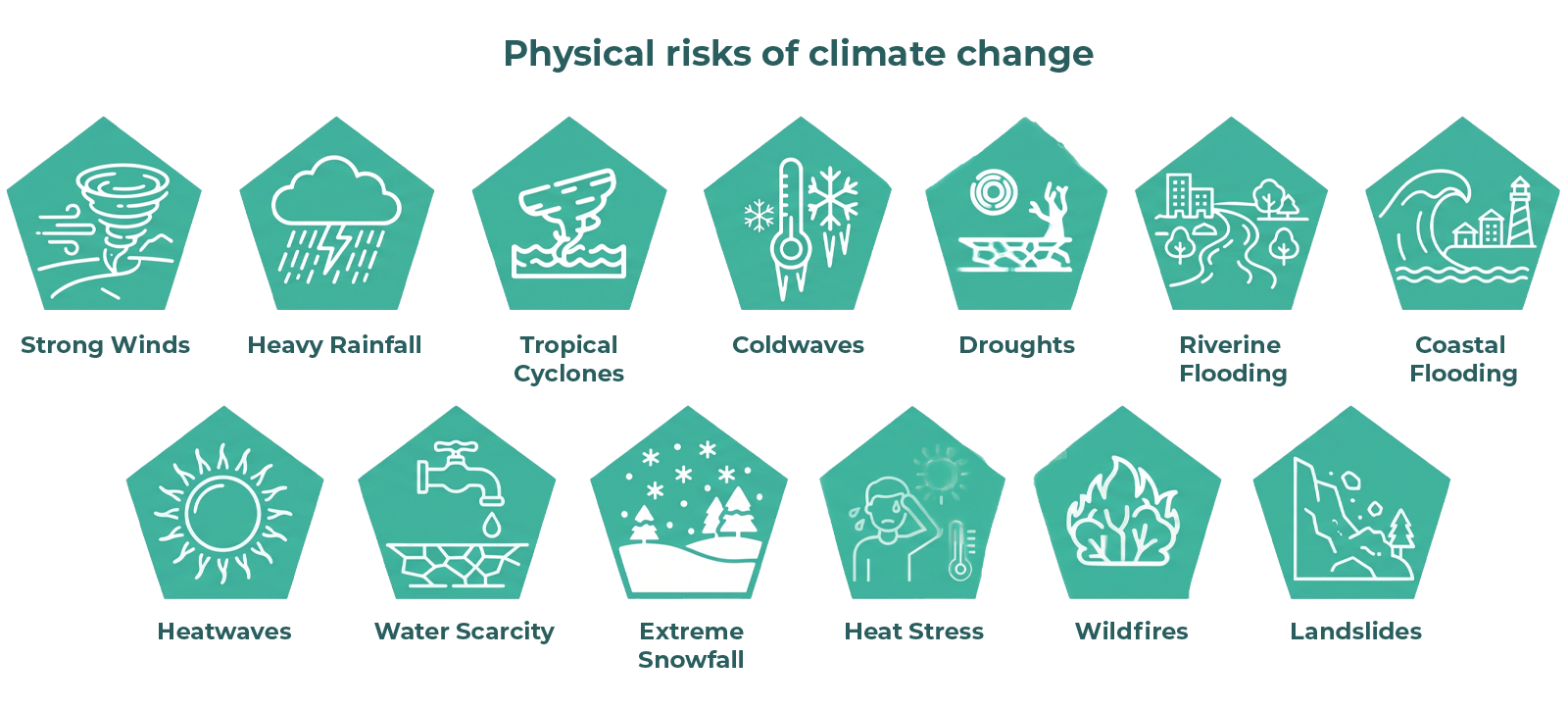
The level of exposure/risk associated with thirteen physical climate hazards (drought, heat stress, heavy rainfall, strong winds, tropical cyclones, river flooding, coastal flooding, wildfires, landslides, extreme snowfall, heat waves, water scarcity, and cold waves) was analyzed for 622 EPL sites, which include all types of businesses.
For the scenario analysis focused on physical risks, the SSP5-8.5 scenario was used, which is considered to have “high physical impact” and is aligned with a temperature increase of +4°C, where a high impact from extreme weather events is expected globally. The time horizons evaluated were the short term (2027), the medium term (2030), and the long term (2050).
Of the thirteen physical climate threats, three physical risks with the greatest impact were identified, namely:
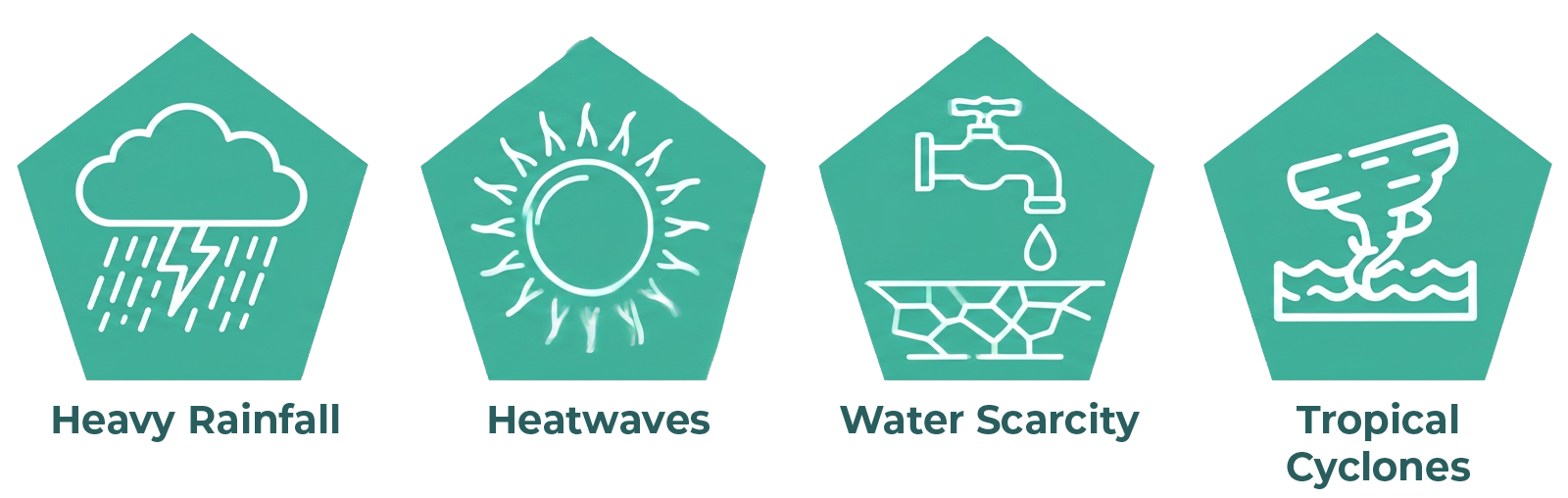
Next, the percentage of vulnerable assets was analyzed, revealing a higher percentage of vulnerable assets with high exposure to heavy rainfall and heat waves, reaching levels of up to 96% of EPL’s total assets by 2050. In third place is water scarcity, with impacts affecting up to 73% of EPL’s assets.
EPL currently has resilience measures in place to help mitigate the impact of climate risks; however, the company will work to develop a Climate Resilience Plan aligned with the Risk Management Model to strengthen existing controls and implement new mechanisms that help reduce risks and continue to ensure business continuity.
Transition risks are those associated with the transition to a low-carbon economy that limits global warming to 1.5 °C above pre-industrial levels by the end of the century.
Climate opportunities are the economic, social, and operational benefits that arise from adapting processes, products, or business models to the transition toward a low-carbon, climate-resilient economy.

The transition risks and opportunities across the nine relevant TCFD/ISSB categories were assessed:
For the scenario analysis focused on transition risks and opportunities, two scenarios were used: the SSP5-8.5 scenario, which is considered to have “high physical impact” and is aligned with a temperature increase of +4°C, where a high global impact from extreme weather events is expected; and the IEA NZE scenario, which assumes a rapid transition aligned with a temperature increase of 1.5°C, which requires large-scale political momentum and climate ambition to limit global warming to 1.5 °C. The time horizons evaluated were the short term (2027), the medium term (2030), and the long term (2050).
The results of the vulnerability analysis were obtained for both risks and opportunities, which are described in the following table:
| Risk / Opportunity | Transition Event Exposure Rating | Vulnerability Rating | Impact Rating | Potential Financial Impact | Percentage of Activities Vulnerable to Transition Risks |
|---|---|---|---|---|---|
| Market Risk Decrease in product demand |
High | Low | Moderate | Revenue reduction due to lower demand for products and services | 100% of products purchased by EPL can be impacted by carbon pricing |
| Policy / Legal Risk Policies promoting the circular economy |
High | Moderate | High | Increase in indirect costs | 45% of EPL sites are located in states with circular economy or waste management legislation |
| Policy / Legal Risk Introduction and expansion of carbon pricing mechanisms |
High | Moderate | High | Increase in direct and indirect costs | 42% of EPL's GHG emissions in 2024 are located in states with carbon pricing |
| Risk / Opportunity | Transition Event Exposure Rating | Vulnerability Rating | Impact Rating | Potential Financial Impact | Percentage of Activities Vulnerable to Transition Risks |
|---|---|---|---|---|---|
| Resource Efficiency Opportunity Advances in goods transport and distribution technologies |
Very high | Moderate | Very high | Return on investment in low-emission technologies and reduction of indirect costs | 85% of the last-mile vehicle fleet is not electrified |
| Resource Efficiency Opportunity Use of energy-efficient building technologies |
High | Moderate | High | Return on investment in low-emission technologies and reduction of indirect costs | 91% of total EPL sites do not have solar panels installed |
EPL currently has resilience measures in place that help mitigate the impact of transition risks; however, the company will work to develop a Climate Resilience Plan aligned with the Risk Management Model to strengthen existing controls and implement new mechanisms that help reduce risks and continue to ensure business continuity.
In 2024, work was conducted on an in-depth analysis of two critical risks: water scarcity and carbon prices. This analysis is part of an iterative process of continuous improvement aimed at strengthening adaptation and resilience capabilities.
The study covered the time horizons of 2030 and 2050 using the IPCC climate models SSP3-7.0 (3.6 °C) and SSP5-8.5 (>4 °C) and included an assessment of more than 370 locations in critical hydrological regions of Mexico. The results show that 73% of our locations are in areas with high or very high levels of water stress, which poses an operational risk in the event of prolonged water shortages.
An economic analysis of carbon price exposure was conducted by modeling short-, medium-, and long-term scenarios using the International Energy Agency’s (IEA) models under the following scenarios: Net Zero Emissions by 2050 (NZE, +1.5°C), Announced Policies (APS, +1.7°C), and Stated Policies (STEPS, +2.5°C). This exercise allowed us to estimate the financial impacts under different carbon price levels, including shadow prices and anticipated national policies.
These efforts are already being factored into operational planning and investment decision-making processes. They reinforce the vision of building a resilient company committed to the sustainable development of its operations, customers, and communities.CAPEX for the 2025 Footprint
During fiscal year 2025, the Port of Liverpool allocated a total capital expenditure (CAPEX) of 144.8 million pesos (MXN) focused on strengthening climate resilience and advancing the transition to a low-carbon economy. This investment was incorporated into the financial planning processes and was duly budgeted and authorized, with priorities set based on criteria of financial viability, reduction emissions and the mitigation of both physical and transition-related climate risks.
This capital was allocated across three strategic operational areas:
Energy Efficiency and Renewable Energy: 106.6 million MXN allocated to the installation of solar panels (at 53 company-owned locations), submetering systems, and energy-efficiency technologies in buildings.
Water Management and Resilience: MXN 35.2 million allocated to infrastructure aimed at reducing potable water consumption and increasing treated water supply, including the installation of wastewater treatment plants (WWTPs), connections to third-party WWTPs, the replacement of plumbing fixtures with more efficient systems, and stormwater harvesting systems.
Circular Economy and Waste Management: 3.0 million MXN for the development of infrastructure related to the proper separation, handling, and reuse of waste at the source.
These investments are an integral part of the strategy for managing the risks and opportunities identified under our Comprehensive Risk Management Model (for its acronym in Spanish, MIGR) and our sustainability strategy, without placing significant pressure on the Company’s liquidity or cash flow generation capacity.